Machining a Large POM Plate to a Controlled Flatness
Large flat POM plate with handle cutouts
| Industry | Precision component manufacturing |
|---|---|
| Part | Large flat POM plate with handle cutouts |
| Material | White POM (acetal), unfilled |
| Batch | Batch production |
The requirement
A component in white POM (acetal) had to be machined from a plate more than 700 mm long, with two handle cutouts, a pattern of small holes and four round bosses. The drawing called for a flatness requirement across the full length of the plate — the dimension that a long plate in a viscoelastic material is least able to hold.
The challenge
POM is dimensionally unstable in a way metals are not. It creeps under a constant load, it responds to its own machining stress, and it changes with temperature and humidity. A plate more than 700 mm long is long enough for every one of those effects to show up as flatness. The material, not the toolpath, decides whether the plate comes off the machine flat.
Our approach
The route was built around the material instead of around the toolpath. The POM stock was stress-relieved first, and the plate was then held under refrigeration for 24 hours. <!-- TODO 确认:冷藏是在机加工之前,还是作为成品后的验证循环?确认后调整本句 --> Milling was done in a balanced, symmetric sequence so that material removal did not itself pull the plate out of plane, and the flatness was verified on our Zeiss CMM under controlled room temperature.
Five steps from drawing to delivery
- DFM review and material plan — The drawing was reviewed for flatness, thickness and the hole pattern before any blank was cut. Unfilled white POM was confirmed, and the route was planned around the material's behaviour rather than around a fixed machining sequence.
- Stress relief of the stock — The POM stock was stress-relieved so that the residual stress from the extrusion and from the blanking is taken out before the plate is machined to size.
- 24 hours of refrigeration — The plate was held under refrigeration for 24 hours. Acetal responds to temperature, and a plate that has been through a temperature cycle before machining starts from a known state instead of an unknown one.
- Balanced milling and hole pattern — Milling followed a balanced, symmetric sequence, with the hole pattern referenced from the datum face, so that material removal across the length did not itself pull the plate out of plane.
- Inspection and documentation — Flatness was verified on our Zeiss CMM under controlled room temperature, and the measured value is stated on the dimensional report supplied with the batch.
A flat POM plate more than 700 mm long
White POM (acetal), machined from a plate more than 700 mm long, with two handle cutouts at the ends, a pattern of small holes and four round bosses. The length is the point of this case: it is where a plate like this stops behaving like a rigid part and starts behaving like a material that moves.
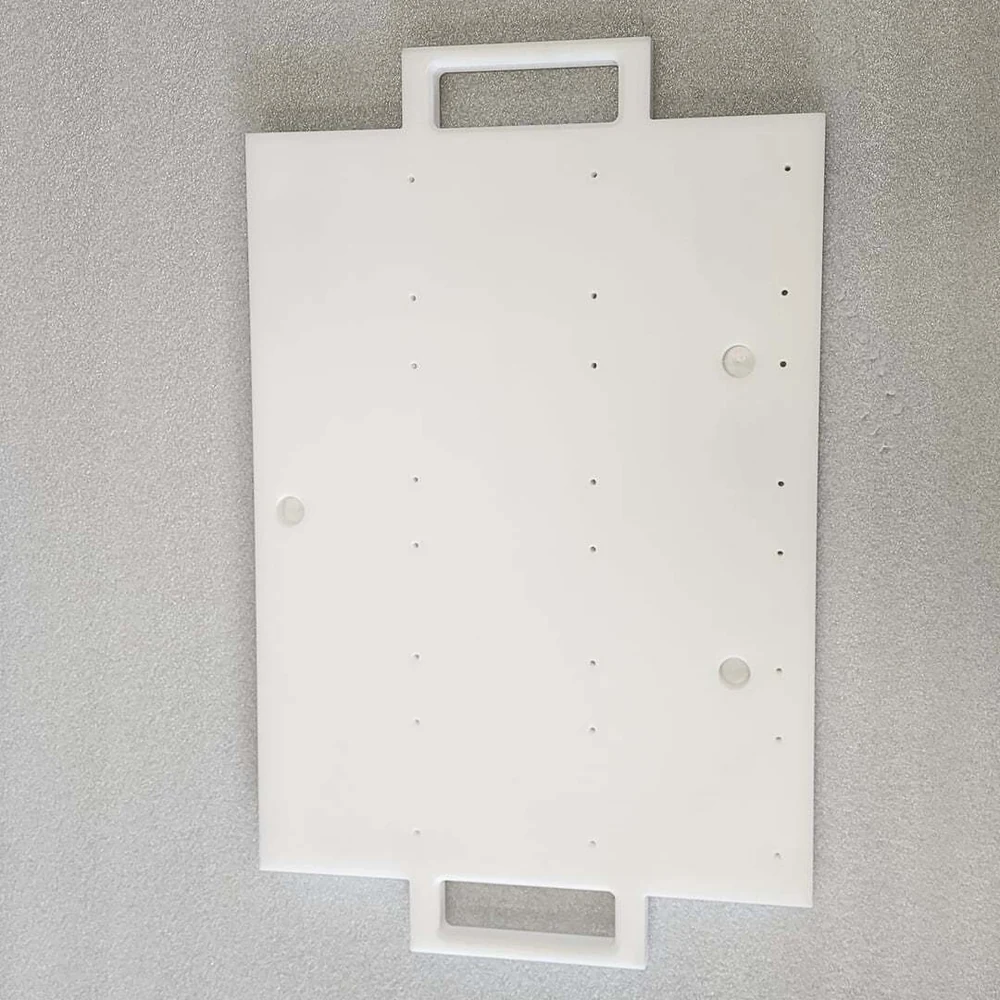
- Material: white POM (acetal), unfilled
- Format: plate over 700 mm long
- Features: two handle cutouts, hole pattern, four round bosses
- Route: stress relief, 24 h refrigeration, balanced milling
- Inspection: Zeiss CMM at controlled room temperature
Your version of this part
This case is one part we have made. If you are working on a large plate in POM or acetal, send the drawing with the thickness and the flatness requirement — we will tell you what is achievable for that combination.